

“f*ck that dough” Amazon’s new book release on startup success without investors
image for illustrative purpose
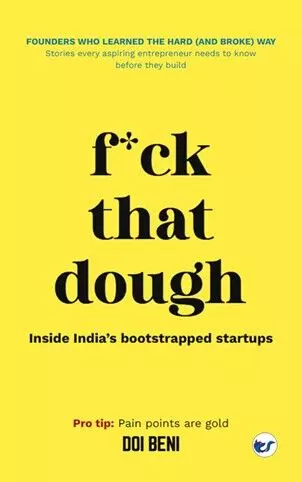
A new, no-nonsense chronicle titled “f*ck that dough” lands on Amazon book store as a bracing reminder that funding is neither the only nor always the best route to scale. Rather than idolizing sky-high valuations and headline-grabbing rounds, the book stitches together first-person accounts and investigative profiles of companies that built their way to market leadership on their own terms: from fintech outlier Zerodha and charting pioneer FusionCharts to HR-platform Keka and the meteoric regional growth of Rameshwaram Café. It also draws provocative parallels to legacy players that behaved like lean startups when the moment demanded it — including vaccine makers Serum Institute of India and Bharat Biotech.
Click the link to get a copy today https://tinyurl.com/43chtun7
The throughline of “f*ck that dough” is simple and urgent: resource constraints force discipline, and discipline breeds repeatable systems that survive volatility. The book’s author frames bootstrapping not as a handicap but as a design choice — one that rewards durability over optics. Across the profiles, a few recurring themes emerge: product-first focus, tight unit economics, ruthless prioritization of customer value, and a willingness to pivot when survival required it.
Zerodha’s section is the book’s clearest manifesto for founder-led, capital-light scale. Founded by Nithin and Nikhil Kamath in 2010, Zerodha set out to solve problems its founders themselves had wrestled with as traders and did so without the trappings of venture capital. The book revisits how Zerodha leveraged technology, transparent pricing, and community education to chip away at incumbents while keeping costs lean and control in-house. The account echoes the company’s public narrative about being a bootstrapped, founder-led disruptor that rewrote the economics of broking in India.
Another early chapter follows FusionCharts, the data-visualization startup that began as a lone developer’s side project and grew into a global component provider used by enterprises and product teams alike. The author traces the classic accidental-entrepreneur arc: small, pragmatic decisions about licensing, developer outreach, and product quality compounded into sustainable revenue long before the buzzwords arrived. FusionCharts’ story, as told in the book, is a study in treating commercial software as a slow, compounding product business rather than a viral unicorn chase.
Keka — an HR-tech platform that chose organic growth over venture dollars is presented as a modern case study in founder restraint. Founder Vijay Yalamanchili’s decision to pour personal savings into a product-led offering, keep hiring disciplined, and focus obsessively on net retention is portrayed as the practical flip side of Silicon Valley’s “grow at all costs” lore. The book highlights how Keka’s steady, cash-flow-focused path enabled it to build deep product-market fit and profitable unit economics — the sort of foundation that venture-driven companies sometimes sacrifice for fast expansion.
Not all stories in “f*ck that dough” are software success tales. The author includes Rameshwaram Café, a regional food brand that scaled consistent south-Indian cuisines with franchise-like discipline and a founding team that treated operations as the product. The café’s rise from modest beginnings to multi-crore revenues in a few years becomes in the book an example of how relentless execution and replicable standards can convert a culinary idea into a growth engine without outside capital, by focusing on unit-level profitability and repeat customers.
The book widens the frame by showing how established firms can behave like startups when crisis or opportunity forces them to. Two pharmaceutical companies Serum Institute of India and Bharat Biotech are profiled as legacy organizations that applied startup-style speed and iteration to massive public-health problems. Serum Institute, founded in 1966 and long a global vaccine manufacturer, is portrayed as having leaned into agile scale-up during crucial moments in recent years, rapidly expanding capacity and international partnerships while maintaining an intense manufacturing focus. Bharat Biotech’s trajectory is cast similarly: a Hyderabad-based vaccine developer that has repeatedly taken on hard biological problems, innovating in-house and partnering for scale when needed. These chapters argue that “startup efficiency” is not solely the domain of software — it’s a mindset any firm can adopt.
Beyond the names, the book is notable for its granular, sometimes uncomfortable lessons. Founders recount nights of missed salaries, iterative product kills, and the hard calculus that decides when bootstrapping becomes a straightjacket. The narrative resists heroification: success is shown as accumulation of sensible, repeatable choices rather than a single clever hack or inspirational quote. Readers get operational takeaways — how to design subscription pricing that survives churn, how to structure early hiring to avoid cultural debt, and how to set KPIs that don’t reward vanity.
Critically, “f*ck that dough” also addresses the trade-offs founders accept when they say no to capital. Speed and reach can be slower; marketing budgets smaller; hiring sometimes conservative. But the book contends that this trade-off buys independence: the latitude to focus on long-term unit economics, to avoid dilution of mission, and to make unpopular but necessary operational choices. The author doesn’t argue that bootstrapping is superior in all contexts — rather, that it’s an under-covered, viable strategy that deserves more nuanced coverage than “VC or bust.”
Industry observers quoted in the book underscore why these stories matter now. With public markets cooling and capital becoming pricier, many founders are being forced to ask the same questions the bootstrapped cohort solved years ago: how do you build a defensible business that survives stress without constant infusions of external cash? The book positions these case studies as templates for resilience: ways of structure, hiring, and engineering that can outlast cycles.
If the book has a manifesto line, it is this: scarcity clarifies. Scarcity forces teams to make decisions that scale sustainably. Scarcity teaches teams to obsess over retention and margin rather than vanity growth. And, the book suggests, the discipline born of constraint often produces products and businesses that persist when the hype fades.
“f*ck that dough” will likely be read differently by different audiences. For aspiring founders, it’s a tactical manual of hard-won practices. For investors, it’s a reminder that durable businesses can — and do — come from outside the VC pipeline. For policy-makers and ecosystem builders, it raises questions about how to nurture capital-efficient firms and celebrate profitability, not just valuations.
Whether readers adopt its ethos wholesale or cherry-pick practices, the book’s broader contribution is cultural: it normalizes alternative pathways to scale at a time when fundraising has been the shorthand for ambition. In doing so, “f*ck that dough” stakes a claim in the startup canon not as an argument for strategy over spectacle.





